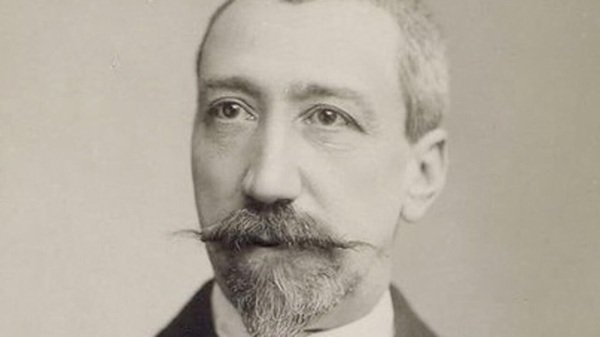
Anatole France -François-Anatole Thibault (1844 –1924) was a French poet, journalist, and novelist with several best-sellers. Ironic and skeptical, he was considered in his day the ideal French man of letters. He was a member of the Académie française, and won the 1921 Nobel Prize in Literature “in recognition of his brilliant literary achievements, characterized as they are by a nobility of style, a profound human sympathy, grace, and a true Gallic temperament”.
France is also widely believed to be the model for narrator Marcel’s literary idol Bergotte in Marcel Proust‘s In Search of Lost Time
Literary career
France began his literary career as a poet and a journalist. In 1869, Le Parnasse Contemporain published one of his poems, “La Part de Madeleine”. In 1875, he sat on the committee in charge of the third Parnasse Contemporain compilation. As a journalist, from 1867, he wrote many articles and notices. He became known with the novel Le Crime de Sylvestre Bonnard (1881). Its protagonist, skeptical old scholar Sylvester Bonnard, embodied France’s own personality. The novel was praised for its elegant prose and won him a prize from the Académie française.
In La Rotisserie de la Reine Pedauque (1893) France ridiculed belief in the occult; and in Les Opinions de Jérôme Coignard (1893), France captured the atmosphere of the fin de siècle. He was elected to the Académie française in 1896.
France took a part in the Dreyfus affair. He signed Émile Zola‘s manifesto supporting Alfred Dreyfus, a Jewish army officer who had been falsely convicted of espionage. France wrote about the affair in his 1901 novel Monsieur Bergeret.
France’s later works include L’Île des Pingouins (Penguin Island, 1908) which satirizes human nature by depicting the transformation of penguins into humans – after the birds have been baptized by mistake by the almost-blind Abbot Mael. It is a satirical history of France, starting in Medieval times, going on to the author’s own time with special attention to the Dreyfus affair and concluding with a dystopian future. Les dieux ont soif (The Gods Are Athirst, 1912) is a novel, set in Paris during the French Revolution, about a true-believing follower of Maximilien Robespierre and his contribution to the bloody events of the Reign of Terror of 1793–94. It is a wake-up call against political and ideological fanaticism and explores various other philosophical approaches to the events of the time. La Revolte des Anges (Revolt of the Angels, 1914) is often considered Anatole France’s most profound and ironic novel. Loosely based on the Christian understanding of the War in Heaven, it tells the story of Arcade, the guardian angel of Maurice d’Esparvieu. Bored because Bishop d’Esparvieu is sinless, Arcade begins reading the bishop’s books on theology and becomes an atheist. He moves to Paris, meets a woman, falls in love, and loses his virginity causing his wings to fall off, joins the revolutionary movement of fallen angels, and meets the Devil, who realizes that if he overthrew God, he would become just like God. Arcade realizes that replacing God with another is meaningless unless “in ourselves and in ourselves alone we attack and destroy Ialdabaoth.” “Ialdabaoth”, according to France, is God’s secret name and means “the child who wanders”.
He was awarded the Nobel Prize in 1921. He died in 1924 and is buried in the Neuilly-sur-Seine community cemetery near Paris.
On 31 May 1922, France’s entire works were put on the Index Librorum Prohibitorum (Prohibited Books Index) of the Catholic Church.[4] He regarded this as a “distinction”. This Index was abolished in 1966
Works
Poetry
- “Les Légions de Varus”, poem published in 1867 in the Gazette rimée.
- Poèmes dorés(1873)
- Les Noces corinthiennes(The Bride of Corinth) (1876)
Prose fiction
- Jocaste et le chat maigre(Jocasta and the Famished Cat) (1879)
- Le Crime de Sylvestre Bonnard(The Crime of Sylvestre Bonnard) (1881)
- Les Désirs de Jean Servien(The Aspirations of Jean Servien) (1882)
- Abeille(Honey-Bee) (1883)
- Balthasar(1889)
- Thaïs(1890)
- L’Étui de nacre(Mother of Pearl) (1892)
- La Rôtisserie de la reine Pédauque(At the Sign of the Reine Pédauque) (1892)
- Les Opinions de Jérôme Coignard(The Opinions of Jerome Coignard) (1893)
- Le Lys rouge(The Red Lily) (1894)
- Le Puits de Sainte Claire(The Well of Saint Clare) (1895)
- L’Histoire contemporaine(A Chronicle of Our Own Times)
- 1: L’Orme du mail(The Elm-Tree on the Mall)(1897)
- 2: Le Mannequin d’osier(The Wicker-Work Woman) (1897)
- 3: L’Anneau d’améthyste(The Amethyst Ring) (1899)
- 4: Monsieur Bergeret à Paris(Monsieur Bergeret in Paris) (1901)
- Clio(1900)
- Histoire comique(A Mummer’s Tale) (1903)
- Sur la pierre blanche(The White Stone) (1905)
- L’Affaire Crainquebille(1901)
- L’Île des Pingouins(Penguin Island) (1908)
- Les Contes de Jacques Tournebroche(The Merrie Tales of Jacques Tournebroche) (1908)
- Les Sept Femmes de Barbe bleue et autres contes merveilleux(The Seven Wives of Bluebeard and Other Marvelous Tales) (1909)
- Les dieux ont soif(The Gods Are Athirst) (1912)
- La Révolte des anges(The Revolt of the Angels) (1914)
Memoirs
- Le Livre de mon ami(My Friend’s Book) (1885)
- Pierre Nozière(1899)
- Le Petit Pierre(Little Pierre) (1918)
- La Vie en fleur(The Bloom of Life) (1922)
Plays
- Au petit bonheur(1898)
- Crainquebille(1903)
- La Comédie de celui qui épousa une femme muette(The Man Who Married A Dumb Wife) (1908)
- Le Mannequin d’osier(The Wicker Woman) (1928)
Historical biography
- Vie de Jeanne d’Arc(The Life of Joan of Arc) (1908)
Literary criticism
- Alfred de Vigny(1869)
- Le Château de Vaux-le-Vicomte(1888)
- Le Génie Latin(The Latin Genius) (1909)
Social criticism
- Le Jardin d’Épicure(The Garden of Epicurus) (1895)
- Opinions sociales(1902)
- Le Parti noir(1904)
- Vers les temps meilleurs(1906)
- Sur la voie glorieuse(1915)
- Trente ans de vie sociale, in four volumes, (1949, 1953, 1964, 1973)
External links
- Works by Anatole Franceat Project Gutenberg
- List of Works
- Works by or about Anatole Franceat Internet Archive
- Works by Anatole Franceat LibriVox (public domain audiobooks)
- Works by Anatole Franceat Open Library
- Anatole Franceon Nobelprize.org
- “Anatole France, Nobel Prize Winner”by Herbert S. Gorman, The New York Times, 20 November 1921
- Correspondence with architect Jean-Paul Ouryat Syracuse University
- Université McGill: le roman selon les romanciers
- Anatole France, his work in audio version (in French)
- Anatole Franceat Find a Grave
Download and enjoy the works of Anatole France that we offer you at Word Reading Club:
| Bee The Princess of the Dwarfs | Novel |
| Clio | Novel |
| The Amethyst Ring | Novel |
| The Aspirations of Jean Servien | Novel |
| The Crime of Sylvestre Bonnard | Novel |
| The Elm-tree on the Mall | Novel |
| The Revolt of the Angels | Novel |
| Balthasar and Other Works | Collected Tales |
| Child Life In Town And Country | Tale |
| The Seven Wives Of Bluebeard | Tale |
| The Story Of The Duchess Of Cicogne And Of Monsieur De Boulingrin | Tale |