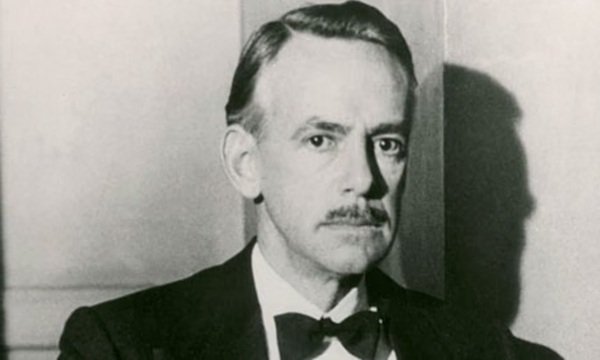
Eugene Gladstone O’Neill (1888 – 1953) was an American playwright. His poetically titled plays were among the first to introduce into the U.S. the drama techniques of realism, earlier associated with Chekhov, Ibsen, and Strindberg. The tragedy Long Day’s Journey into Night is often included on lists of the finest American plays in the 20th century, alongside Tennessee Williams’s A Streetcar Named Desire and Arthur Miller’s Death of a Salesman. He was awarded the 1936 Nobel Prize in Literature. O’Neill is also the only playwright to win four Pulitzer Prizes for Drama.
O’Neill’s plays were among the first to include speeches in American English vernacular and involve characters on the fringes of society. They struggle to maintain their hopes and aspirations, ultimately sliding into disillusion and despair. Of his very few comedies, only one is well known (Ah, Wilderness!). Nearly all of his other plays involve some degree of tragedy and personal pessimism.
Career
After returning to New York and living in poverty, O’Neill attempted suicide in 1912 in his room at Jimmy-the-Priest’s boarding house and saloon, which — together with the Hell Hole — would one day become the setting for his play The Iceman Cometh. That same year, he and his first wife Kathleen divorced, and he contracted tuberculosis. It was during his recovery at a sanatorium — which he came to regard as his “rebirth” — that he determined he would become a playwright. “I want to be an artist or nothing,” he said.
After recovering from tuberculosis, he decided to devote himself full time to writing plays (the events immediately prior to entering the sanatorium are dramatized in his masterpiece, Long Day’s Journey into Night). O’Neill had previously been employed by the New London Telegraph, writing poetry as well as reporting. In the fall of 1914, O’Neill studied at Harvard University with George Pierce Baker, who ran a famous course called “Workshop 47” that taught the fundamentals of playwriting, but left after one year.
During the 1910s, O’Neill was a regular on the Greenwich Village literary scene, where he also befriended many radicals, most notably Communist Labor Party of America founder John Reed. O’Neill also had a brief romantic relationship with Reed’s wife, writer Louise Bryant.
In an early one-act play, The Web, written in 1913, O’Neill first explored the darker themes that he later thrived on. Here he focused on the brothel world and the lives of prostitutes, which also play a role in some fourteen of his later plays. In particular, he memorably included the birth of an infant into the world of prostitution. At the time, such themes constituted a huge innovation, as these sides of life had never before been presented with such success.
O’Neill’s first published play, Beyond the Horizon, opened on Broadway in 1920 to great acclaim and was awarded the Pulitzer Prize for Drama. His first major hit was The Emperor Jones, which ran on Broadway in 1920 and obliquely commented on the U.S. occupation of Haiti that was a topic of debate in that year’s presidential election. His best known plays include Anna Christie (Pulitzer Prize 1922), Desire Under the Elms (1924), Strange Interlude (Pulitzer Prize 1928), Mourning Becomes Electra (1931), and his only well known comedy, Ah, Wilderness!, a wistful re-imagining of his youth as he wished it had been.
O’Neill was elected to the American Philosophical Society in 1935.[21] In 1936 O’Neill received the Nobel Prize in Literature after he had been nominated that year by Henrik Schück, member of the Swedish Academy. O’Neill was profoundly influenced by the work of Swedish writer August Strindberg, and, upon receiving the Nobel Prize, dedicated much of his acceptance speech to him.
After a ten-year pause, O’Neill’s now renowned play The Iceman Cometh was produced in 1946. The following year’s A Moon for the Misbegotten failed, and it was decades before the piece came to be considered as among his best works
He was also part of the modern movement to partially revive the classical heroic mask from ancient Greek theatre and Japanese Noh theatre in some of his plays, such as The Great God Brown and Lazarus Laughed.
Illness and death
After suffering from multiple health problems (including depression and alcoholism) over many years, O’Neill ultimately faced a severe Parkinson’s-like tremor in his hands that made it impossible for him to write during the last ten years of his life; he tried dictation but found himself unable to compose that way. While at Tao House, O’Neill had intended to write a collection of works he called “the Cycle”, chronicling American life spanning from 1755 to 1932. Only two of the eleven plays O’Neill proposed, A Touch of the Poet and More Stately Mansions, were completed. As his health worsened, O’Neill lost inspiration for the project and wrote three largely autobiographical plays, The Iceman Cometh, Long Day’s Journey into Night, and A Moon for the Misbegotten, which he completed in 1943, just before leaving Tao House and losing his ability to write. The book “Love and Admiration and Respect”: The O’Neill-Commins Correspondence” includes an extended account written by Saxe Commins, O’Neill’s publisher, in which he talks of “snatches of dialogue” between Carlotta and O’Neill over the disappearance of a group of manuscripts that O’Neill had brought with him from San Francisco. “When the table was cleared I learned the cause of the tension; the manuscripts were lost. They had disappeared mysteriously during the day and there was no clue to their whereabouts.”
O’Neill died at the Sheraton Hotel (now Boston University’s Kilachand Hall) on Bay State Road in Boston on November 27, 1953, at age 65.
In 1956 Carlotta arranged for his autobiographical play Long Day’s Journey into Night to be published, although his written instructions had stipulated that it not be made public until 25 years after his death. It was produced on stage to tremendous critical acclaim and won the Pulitzer Prize in 1957. It is widely considered his finest play. Other posthumously published works include A Touch of the Poet (1958) and More Stately Mansions (1967).
Work
See also: Category:Plays by Eugene O’Neill
Full-length plays· Bread and Butter, 1914 · Servitude, 1914 · The Personal Equation, 1915 · Now I Ask You, 1916 · Beyond the Horizon, 1918 – Pulitzer Prize, 1920 · The Straw, 1919 · Chris Christophersen, 1919 · Gold, 1920 · Anna Christie, 1920 – Pulitzer Prize, 1922 · The Emperor Jones, 1920 · Diff’rent, 1921 · The First Man, 1922 · The Hairy Ape, 1922 · The Fountain, 1923 · Marco Millions, 1923–25 · All God’s Chillun Got Wings, 1924 · Welded, 1924 · Desire Under the Elms, 1924 · Lazarus Laughed, 1925–26 · The Great God Brown, 1926 · Strange Interlude, 1928 – Pulitzer Prize · Dynamo, 1929 · Mourning Becomes Electra, 1931 · Ah, Wilderness!, 1933 · Days Without End, 1933 · More Stately Mansions, written 1937-1938, first performed 1967 · The Iceman Cometh, written 1939, published 1940, first performed 1946 · Long Day’s Journey into Night, written 1941, first performed 1956; Pulitzer Prize 1957 · A Moon for the Misbegotten, written 1941–1943, first performed 1947 · A Touch of the Poet, completed in 1942, first performed 1958 |
One-act playsThe Glencairn Plays, all of which feature characters on the fictional ship Glencairn—filmed together as The Long Voyage Home: · Bound East for Cardiff, 1916 · In the Zone, 1917 · The Long Voyage Home, 1917 · Moon of the Caribbees, 1918 Other one-act plays include: · A Wife for a Life, 1913 · The Web, 1913 · Thirst, 1913 · Recklessness, 1913 · Warnings, 1913 · Fog, 1914 · Abortion, 1914 · The Movie Man: A Comedy, 1914 · The Sniper, 1915 · Before Breakfast, 1916 · Ile, 1917 · The Rope, 1918 · Shell Shock, 1918 · The Dreamy Kid, 1918 · Where the Cross Is Made, 1918 · Exorcism, 1919 · Hughie, written 1941, first performed 1959 |
Other works
- Tomorrow, 1917. A short-story published in The Seven Arts, Vol. II, No. 8 in June 1917.
- O.S., 1918. A short-story based on his 1913 one-act play Warnings.
- The Ancient Mariner, 1923, a dramatic arrangement of Coleridge’s poem.
- The Last Will and Testament of an Extremely Distinguished Dog, 1940. Written to comfort Carlotta as their “child” Blemie was approaching his death in December 1940.
- Poems: 1912-1944, published 1980.
- Eugene O’Neill at Work: Newly Released Ideas for Plays, published 1981. Annotated notebooks written between 1918 and 1943 containing notes on plays published, unpublished, and unfinished.
- The Calms of Capricorn, unfinished play, published in 1983.
- The Unknown O’Neill: Unpublished Or Unfamiliar Writings of Eugene O’Neill, published in 1988.
- The Unfinished Plays: Notes for The Visit of Malatesta, The Last Conquestand Blind Alley Guy, published in 1988
External links
Digital collections
- Works by Eugene O’Neill in eBook format Standard Ebooks
- Works by Eugene O’Neillat Project Gutenberg
- Works by Eugene O’Neillat Project Gutenberg Australia
- Works by Eugene O’Neillat Open Library
- Works by or about Eugene O’Neillat the Internet Archive
- Works by Eugene O’Neillat LibriVox (public domain audiobooks)
- Works by Eugene O’Neill[dead link](public domain in Canada)
External entries
- Eugene O’Neillat the Internet Broadway Database
- Eugene O’Neillat the Internet Off-Broadway Database (archived)
- Eugene O’Neillat IMDb
- Eugene O’Neillat Playbill Vault (archive)
Other sources
- Eugene O’Neill official website
- Casa Genotta official website
- Eugene O’Neill National Historic Site
- American Experience – Eugene O’Neill: A Documentary Film on PBSArchived February 1, 2017, at the Wayback Machine
- Eugene O’Neillon Nobelprize.org